
Budgeting when you get paid biweekly comes down to one thing: your paydays move around the calendar and your bills do not. Line those two up and the rest gets simple fast.
Getting paid every other week means twenty-six paychecks a year. Most months you get two. Twice a year you get three.
That third paycheck is the part people either love or lose track of, and we will get to it. First, the setup.

Table of Contents
How to Create a Biweekly Budget with Monthly Bills
The whole system rests on knowing which bills each individual paycheck is responsible for, rather than looking at the month as one lump.
Start by listing every bill with its due date. Then pull up your paydays for the next two months. Because your paydays drift and your due dates stay put, the pairing changes month to month, and that is exactly what trips people up around week three.
Once both sets of dates are on the same calendar, you assign each bill to the paycheck that lands before it. That is the entire method.
Step 1: Create Your Monthly Budget Categories
Getting paid once a month, twice a month, every week doesn’t matter. You need to know where your money is going, so start by listing out your monthly expenses, including due dates.
Groceries. Utilities. Mortgage payment. Gas. Insurance. Car Payment. Cell Phone. Internet. Haircuts. Clothing. Gym. Credit Card debt payments.
Once you know what money you need, you will be in great shape to organize yourself and your money to rock your month!
Step 2: Organize Your Bills and Expenses Utilizing a Bill Pay Calendar
Google Calendar is a fantastic free tool to help keep your finances organized and on track.
I use it daily to help me stay on top of the rest of my daily life, and budgeting is no exception.
Part of it is that the visualization really helps me understand what’s happening each month and the bonus of getting the email reminders, so I don’t forget due dates and how I’ve allocated funds in my budget.
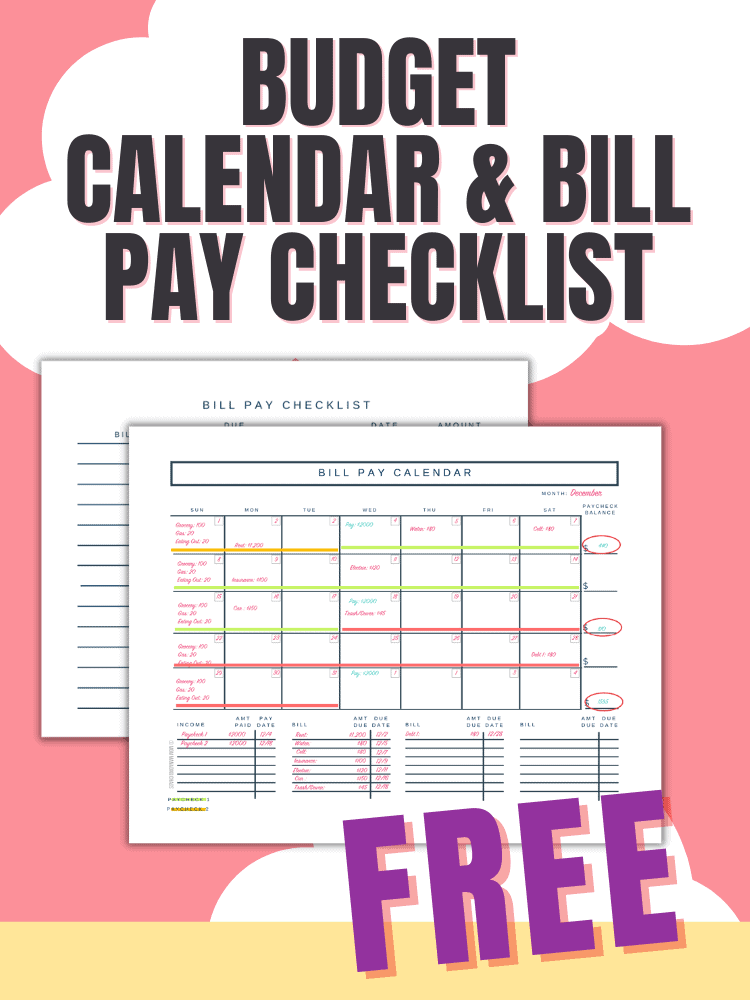
If you want to get a jump start with getting your money organized, be sure to grab your very own budgeting and bill pay calendar.
DON’T MISS IT!
Drop your email address below to grab your free Budgeting Calendar and join a community of 36K other busy budgeters!
By entering your email address, you are agreeing to our Privacy Policy and European users agree to the data transfer policy.
It’s a great way to get a snapshot of your monthly budget and an easy way to check for places your month is outpacing your money.
If you are looking for a biweekly budget template, one is included in Biweekly Budget Blueprint planner.
This budgeting planner was designed specifically with biweekly budgeters in mind. It includes over 100 pages of tools, trackers, and more to get ahead with your money.
It also includes a monthly budget based on a biweekly pay template made in Google Sheets (or Excel, if you prefer) are available.
Be sure to check it out if you are ready to move to the next step with your finances.


Step 3: Create a Zero Based Budget for Each Paycheck
With a zero-based budget, you’re going to look at your income and expenses and give every dollar a job to meet your financial obligations and reach your financial goals for the future.
When your paycheck comes in, you are going to assign 100% of your income to an expenses or category until you have planned out every dollar.
Before you start getting panicky, please realize that just because your budget is planned down to zero, doesn’t mean you are left with zero dollars at the end of that paycheck cycle.
Rather it means you are utilizing every penny to its maximum and most efficient potential.
Something else to think about is to consider breaking larger expenses into 2 payments. Expenses like your mortgage payment.
It can help keep a more even budget across the month when you create half payments for large expenses– this method is called the half payment method.
Super simple. Super effective.
A Biweekly Budget Example You Can Copy
Here is what this looks like with numbers on it. Say you bring home $1,600 per paycheck, paid on the 3rd and the 17th.
Your bills:
Rent $1,200, due the 1st
Car payment $340, due the 10th
Electric $160, due the 12th
Insurance $130, due the 20th
Phone and internet $150, due the 22nd
Groceries and gas, roughly $700 a month
Paycheck one, the 3rd:
Car payment $340
Electric $160
Groceries and gas for two weeks, $350
Half of next month’s rent, $600
Sinking funds $100
Left over: $50
Paycheck two, the 17th:
Insurance $130
Phone and internet $150
Groceries and gas for two weeks, $350
Half of next month’s rent, $600
Sinking funds $100
Left over: $270
Look at what happened with the rent. It got split in half across both paychecks, and it is paying next month’s rent rather than this month’s. That is the half payment method doing its job. One paycheck no longer gets flattened by a $1,200 bill, because both carry $600 of it.
If you are not a month ahead yet, run the same split on the current month. Paycheck one sets aside its $600, paycheck two adds the other $600 and pays the rent. Same structure, one month behind, and you can build toward getting ahead from there.
In a three paycheck month, that extra check arrives with no bills assigned to it at all, because the first two already covered everything. That is the whole reason it feels like free money, and why it is worth deciding where it goes before it lands.
Your numbers will look nothing like these. The structure is the part that transfers: every bill assigned to a specific paycheck, big bills cut in half, and nothing left to sort out at the last minute.
Step 4: Tracking your money
Tracking where your money has gone is typically where most people get frustrated and bail, but this is a super important step in sticking with your budget and subsequently meeting your personal finance goals.
One of the reasons I really love having my bills in a separate checking account from discretionary income is that I always know that the money in my second (discretionary account) is where I really need to focus my tracking and I know I’m not in danger of spending money I need for my bills.
Some people really enjoy the 50/30/20 Budgeting method because they can give themselves permission to spend that 20% of wants any way they like and they call it good.
People who are on tighter budget can do well with cash budgeting and using envelopes. This form of budgeting makes it really hard for you to accidentally overspend categories.
No matter where you land with your tracking tactics, it’s important that you have one and are consistent so you can win with your money!
Bonus: What Else You Need to know about biweekly budgeting
Why you should consider saving up to cover a month’s expenses…
A goal of mine is to save up enough money for a month’s worth of expenses. I can’t imagine too many things more stressful than living paycheck to paycheck. Getting a month ahead helps to alleviate the stress for a few reasons.
First, you won’t be getting paid on the same day of the month every month, but typically bills are due at the same time every month. So, if you are a month ahead, you will always have the money ready to pay bills as they are due regardless if you are getting paid during the first or second week of the month.
You have the flexibility to pay when it best works for you and the due date versus being forced into a certain window because of your ever-changing pay date.
Second, peace of mind. If anything unexpected pops up you have time to adjust for that change.
A word of caution– this is not a free for all pot of money. The purpose of this fund is to maximize your flexibility in paying bills. This is also not an emergency fund.
Check yourself, before you wreck yourself!
When you are planning to get a month ahead. You don’t necessarily need to save a months worth of salary– you just need to save enough to cover your necessary expenses.
The point is to have the money to cover next months bills.
I have a baseline budget that consists of just what I need to get by. It doesn’t include entertainment or eating. It doesn’t include any money that I don’t absolutely need.
You want to make sure you have the money for rent, utilities, cell phone, etc. Anything above necessities is a luxury and those are things you could forgo if the money wasn’t there.
Related Biweekly Pay Article: Saving $5000 in 26 weeks
How to help you get ahead of your monthly bills….
If you are on a super tight budget there are tons of options to help yourself get ahead.
Temporarily cut back on other discretionary spending.
- Pick up a side hustle: dog walking, lyft, babysitting, mother’s helper, etc.
- Sell stuff. Check out Ebay, Craigslist, FB Marketplace, or hold your own garage sale.
- Online surveys. Some of my favorite are Swagbucks, Survey Junkie, and Inbox Dollars.
DON’T MISS IT!
Drop your email address below to grab your free Budgeting Calendar and join a community of 36K other busy budgeters!
By entering your email address, you are agreeing to our Privacy Policy and European users agree to the data transfer policy.
What to do with your 2 extra biweekly paychecks during the year?
As I mentioned above twice a year you will get an extra payment.
Here is a list of a few ways you could use those paychecks to get ahead in your financial goals:
- Pay down debt
- Save up to get a month ahead for expenses.
- Put money away for retirement.
- Add extra to your sinking funds: new car, vacation, home/auto maintenance, etc.
- Pay an insurance policy (auto, home, life)
- Grow your emergency fund
- Pay/plan ahead for irregular expenses.
Pitfalls with Budgeting Biweekly paychecks
There are a few areas you need to be aware of when you are trying to balance getting paid every other week.
The Two Extra Paychecks. As I mentioned above, your occasional third paycheck isn’t intended to be a free for all, so much as a potential windfall to help you get ahead. Don’t squander the opportunity.
Failing to plan for the month. You need to be diligent about laying out your whole month, so you don’t run out between payday. This is why I strongly recommend using a calendar to really visualize where and when money needs to be spent.
How do you budget bi weekly? Any tips or hacks to share? I’d love to hear from you, please comment down below.